

If you fix phones for a living, your income is capped by two things: how fast you can work, and how often a repair comes back. Both are decided almost entirely by the tools on your bench. A technician with a $60 hot air gun and a phone held together with hope will spend more time redoing joints than doing repairs.
Below are the five tools that consistently separate a professional bench from a hobbyist one — what each is actually for, and what to look for when you buy.
1. A Temperature-Controlled Hot Air Rework Station
Hot air is the backbone of board-level work. You need it for lifting shields, removing connectors, reflowing underfill, and preheating before micro-soldering. The mistake beginners make is buying on maximum temperature — the number that matters is stability.
A station that drifts 40 °C while you work will cook a flex cable before you notice. Look for:
- Closed-loop temperature control with a thermocouple in the nozzle, not just a dial.
- Airflow you can turn down to a gentle stream — high flow blows small components off the board.
- Interchangeable nozzles in straight and bent shapes, from around 4 mm to 12 mm.
- Auto-cool-down on shutdown, which prevents the heater element from cooking itself.
For most repair work, 350–380 °C with moderate airflow handles iPhone and Samsung flex connectors. If you are doing MacBook or iPad shields, you will want a preheater underneath as well.
2. A Precision Soldering Station with Fine Tips
You will live at 0.1–0.2 mm pitch. A fat conical tip cannot make those joints no matter how steady your hand is. What you want is a station with fast thermal recovery — the ability to dump heat into a ground plane and get back to set temperature in under two seconds.
- Tips in chisel (K), knife (Kn), and fine conical (I) shapes. Buy spares; tips are consumables.
- Sleep mode that drops temperature when idle, extending tip life dramatically.
- Adjustable temperature in 1 °C steps up to at least 400 °C.
Lead-free solder on modern boards needs more heat than the leaded solder most guides were written for. Running too cold is the single most common cause of cold joints and lifted pads.
3. A Stereo Digital Microscope
You cannot fix what you cannot see. A trinocular stereo microscope with 7×–45× zoom is the standard for board work. The third port matters more than people expect — it lets you mount a camera for documentation and customer proof without losing your eyepieces.
- Working distance of 100 mm or more, so there is room for an iron and tweezers.
- Ring light with adjustable intensity — glare on a glossy board hides cracks.
- A heavy boom stand; a wobbling scope is worse than none.
For shops doing primarily screen and battery swaps, a 1080p HDMI inspection camera at 50× is a cheaper compromise and still catches most lifted pads and bridged pins.
4. A Programmer / Serial Interface Tool
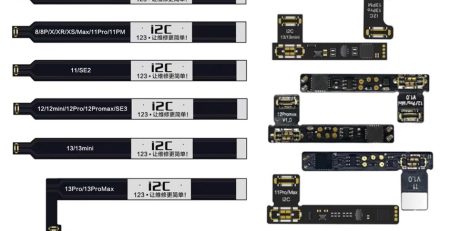
Modern repairs increasingly require talking to the device rather than just replacing parts. Battery health resets, display serial transfer, NAND work, and face-ID module pairing all depend on a programmer that can read and write the relevant chips.
Two things to check before buying: whether the vendor ships current software and firmware (a programmer without updates is a paperweight within a year), and whether the tool supports the specific models you actually see in your shop. General-purpose “universal” programmers usually handle the popular iPhone and Samsung models well and struggle with everything else.
5. An ESD-Safe Bench Setup
Static is invisible and expensive. A single zap you never feel can degrade an IC that fails three weeks later — and the customer blames your repair, not your bench. The setup is cheap:
- An ESD mat grounded through a 1 MΩ resistor.
- A wrist strap you actually wear, tested daily.
- ESD-safe tweezers and drivers — not just any stainless steel.
- No carpet, no synthetic clothing directly over the bench.
What You Can Skip at First
An ultrasonic cleaner is genuinely useful but not urgent. A laser welding machine only pays for itself at volume. Skip both until the five tools above are solid — a mediocre microscope will cost you more in rework than a good one costs to buy.
The Bottom Line
Buy the best hot air station and microscope you can afford, and accept that tips, nozzles, and tweezers are consumables you will replace. Everything else can be upgraded later without slowing you down.
Browse our full range of repair tools and bench equipment, or see the WL Pro 8000 programmer and Quick 861DW replacement handle for a look at what we stock.
Leave a Reply